






Breach, Enforcement and Contract Interpretation
Claims may involve unpaid obligations, failed performance, termination rights, indemnification, warranties or disagreements over the meaning of contract terms.

New Jersey Commercial Litigation Attorneys
ASK Law Firm represents businesses, owners, shareholders and individuals in commercial disputes, contract claims and complex litigation requiring careful strategy, decisive advocacy and attention to the client’s broader objectives.
Strategic Business Dispute Representation
A commercial dispute can affect more than the amount claimed in a lawsuit. It may also disrupt operations, consume management time, damage business relationships and place valuable assets or opportunities at risk.
Some matters can be resolved through focused negotiation, carefully prepared correspondence or mediation. Others require immediate applications, formal discovery, arbitration or litigation through trial and post-judgment enforcement.
ASK Law Firm evaluates the legal claim alongside the client’s commercial priorities, financial exposure, timing concerns and desired result before recommending a strategy.

Understanding the Dispute
Commercial litigation involves disputes arising from business relationships, transactions, contracts, ownership interests, statutory duties and allegedly wrongful commercial conduct.
A company may need to pursue a claim to recover losses, enforce an agreement, prevent continuing misconduct or protect valuable property. It may also need to defend against allegations that threaten its finances, reputation or ability to operate.
The appropriate response depends on the agreements, parties, evidence, available remedies, litigation costs and urgency of the situation. The strongest strategy is not always the most aggressive one; it is the approach most likely to advance the client’s actual objective.
The legal plan should consider cost, speed, leverage, confidentiality, business continuity, collectability and the value of preserving or ending the commercial relationship.
Strategic Commercial Litigation Guidance
Commercial disputes should not be managed through aggression alone. The legal strategy must account for the strength of the claims, available evidence, business risk, litigation costs and the result the client actually needs.
ASK Law Firm reviews the contracts, communications, financial records, ownership structure and conduct of the parties before recommending negotiation, mediation, arbitration, emergency relief or litigation.
Our attorneys also evaluate whether the opposing party has assets, insurance or other means to satisfy a judgment. A courtroom victory has limited value when the recovery cannot be enforced.

Commercial Litigation Matters
Commercial litigation can involve contractual, ownership, financial, employment and competitive disputes that threaten a company’s operations, assets or business relationships.
Claims may involve unpaid obligations, failed performance, termination rights, indemnification, warranties or disagreements over the meaning of contract terms.
Ownership disputes may involve management control, financial access, distributions, fiduciary duties, minority-owner oppression or the separation of business partners.
A claim may arise when a party relies on false representations, omitted information or deceptive conduct in a business transaction.
Disputes may involve interference with contracts, customer relationships, confidential information, trade practices or business opportunities.
Employers, former employees and business owners may dispute the enforceability or violation of contractual restrictions and confidentiality obligations.
Commercial litigation may continue after judgment through asset discovery, collection proceedings and challenges to transfers intended to avoid payment.
The best outcome may involve payment, contract enforcement, injunctive relief, ownership separation, preservation of a business relationship or a prompt and controlled exit from the dispute.
Dispute Resolution Options
Not every commercial dispute requires the same process. The appropriate path depends on the contract, urgency, available leverage, confidentiality concerns and the client’s business priorities.
A carefully prepared demand, response or negotiated resolution may resolve the dispute while controlling cost, publicity and operational disruption.
Mediation may help the parties test their positions, exchange proposals and explore a confidential resolution without surrendering control to a judge.
A contract may require arbitration rather than court litigation. The arbitration clause, chosen rules, discovery limits and available appeal rights should be reviewed carefully.
When negotiated resolution is unavailable or immediate judicial relief is needed, the dispute may proceed through pleadings, discovery, motions, trial and enforcement.
Emergency Business Protection
Some commercial disputes cannot wait for the ordinary litigation schedule. Continuing conduct may threaten assets, confidential information, customer relationships or the viability of the business.
A party may seek temporary or preliminary relief to prevent continuing contractual violations, misuse of information or interference with business operations.
Prompt action may be required when assets are being moved, concealed or depleted in a manner that could frustrate a future judgment.
Court intervention may be necessary when proprietary information, customer data or confidential business materials are being used or disclosed improperly.
A business may seek immediate relief when a former employee, owner or competitor allegedly violates nonsolicitation, confidentiality or related obligations.
Owner disputes may require urgent relief involving access to records, control of accounts, management authority or preservation of company property.
Prompt preservation demands or court applications may be appropriate when electronic data, communications or financial records are at risk.
The requesting party generally must present evidence supporting the required legal standards, immediate risk and need for relief before the ordinary litigation process can run its course.
From Early Review Through Enforcement
The path of a business dispute depends on the contract, claims, defenses, urgency, court, available evidence and possibility of a negotiated resolution.
The attorneys examine the agreements, communications, financial exposure, available remedies and result the client needs before recommending action.
A carefully prepared demand letter, response, preservation notice or direct negotiation may create leverage and resolve the dispute before litigation.
The complaint, answer, counterclaims and related applications frame the legal issues, requested relief and positions of the parties.
The parties may pursue contracts, emails, financial records, databases, written answers, depositions and expert evidence.
The court may decide certain issues through motions. Unresolved claims may proceed to a bench or jury trial depending on the matter.
A favorable judgment may require collection, compliance monitoring, post-judgment discovery or additional enforcement proceedings.
Evidence and Document Preservation
Commercial disputes frequently depend on electronic communications, contracts, financial records, account data and internal business documents.
Once litigation is reasonably anticipated, relevant information may need to be preserved. Routine deletion, document destruction or alteration of records can create serious legal and evidentiary problems.
ASK Law Firm helps identify the people, systems, accounts and documents connected to the dispute so that appropriate preservation and collection steps can be considered early.
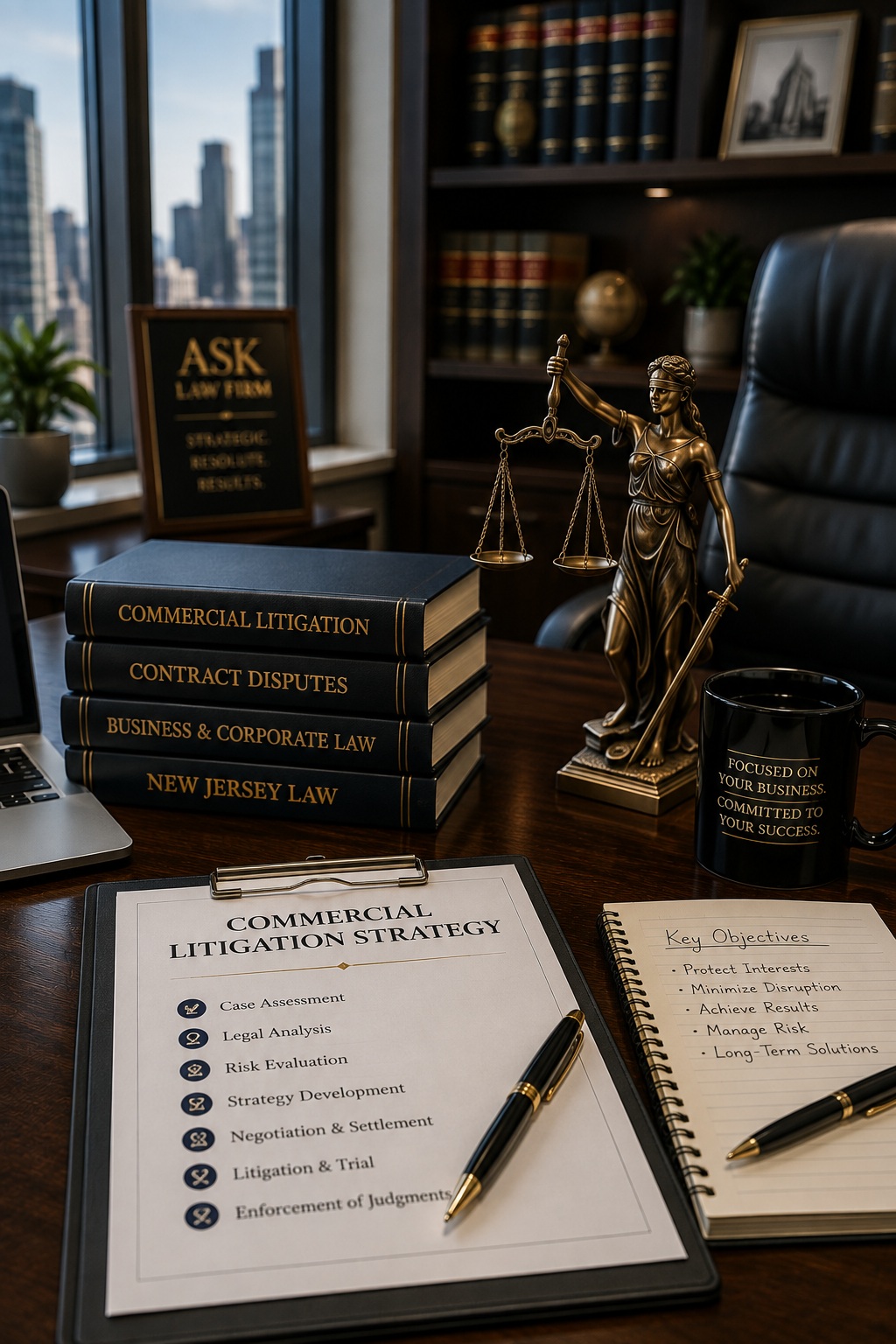
How ASK Law Firm Can Help
Our attorneys address the legal, financial and operational issues involved in the dispute while keeping the client’s business objective at the center of the strategy.
We review the agreements, communications, alleged misconduct, available remedies and financial stakes.
A demand, response, negotiation or preservation notice may protect the client’s position and create an opportunity for early resolution.
We evaluate temporary restraints, injunctions and other urgent remedies when continuing conduct threatens the business.
Our attorneys pursue and analyze contracts, financial data, electronic communications, testimony and expert evidence.
We assess each stage of the dispute to determine whether settlement or continued litigation better serves the client’s interests.
When necessary, our representation continues through post-judgment discovery, asset recovery and enforcement of court-ordered relief.
Beyond the Judgment
Winning a lawsuit does not always result in immediate payment. A judgment creditor may need additional legal steps to identify assets and enforce the judgment.
Post-judgment discovery may be used to identify bank accounts, receivables, real estate, ownership interests and other available assets.
Depending on the debtor and applicable law, enforcement may involve restraints, levies, garnishment or turnover proceedings.
A creditor may seek to reach payments, accounts receivable or other property held by third parties.
Assets transferred to insiders or related businesses may require investigation when the transaction appears designed to frustrate creditors.
Certain ownership interests, distributions or property rights may require specialized enforcement procedures.
When a party defaults under a settlement, additional court proceedings may be needed to enforce the agreement or enter judgment.
The existence, location and legal availability of assets may affect settlement strategy, litigation expense and the practical value of obtaining a judgment.
Why Choose ASK Law Firm
We evaluate cost, timing, leverage, operational impact and collectability alongside the legal merits.
Our attorneys handle disputes from early negotiation and emergency applications through trial and judgment enforcement.
Each matter is developed with settlement, motion practice, arbitration, trial and enforcement needs in mind.
The appropriate approach depends on the agreements, evidence, urgency, business objective, available remedies and financial realities. Past results do not guarantee or predict a similar outcome.
Important Commercial Litigation Information
Commercial litigation often involves more than determining who is legally correct. Businesses frequently need to protect operations, preserve customer relationships, maintain confidential information and control litigation costs while pursuing or defending important legal rights.
Contracts, ownership documents, financial records, electronic communications and business practices may all influence the available legal remedies. Reviewing these materials before positions become entrenched often allows for better planning and stronger negotiation.
Business records may exist across paper files, email accounts, cloud platforms, accounting software, mobile devices and internal databases. Preserving relevant information early may become important as the dispute progresses.
Many commercial disputes resolve before trial. Negotiation, mediation or other forms of dispute resolution may occur before litigation, during discovery or even shortly before trial, depending on the circumstances.
If payment is not made voluntarily, additional legal proceedings may be necessary to enforce the judgment, locate assets or pursue available collection remedies.
Every commercial dispute presents unique legal, financial and operational considerations. An effective strategy should reflect the client's business goals as well as the applicable law and available evidence.
Common questions about business disputes, litigation, contracts, settlement and commercial legal strategy.
Whether your matter involves a contract dispute, shareholder conflict, fraud allegation, business tort or complex commercial litigation, ASK Law Firm is prepared to evaluate your legal options.
Bring any contracts, correspondence, financial records, court documents and other materials related to the dispute for review.