





A serious construction accident can leave you unable to work while medical bills, lost income, and uncertainty about your future continue to build. You may also be dealing with an employer, general contractor, insurance company, or other business that is already working to protect its own interests.
ASK Law Firm LLC helps people in Belmar and throughout New Jersey understand their legal options after construction and jobsite injuries. Depending on how the accident happened, you may have rights through workers’ compensation, a personal injury claim against a third party, or both.
Construction accident cases can involve several contractors, multiple insurance policies, safety responsibilities, equipment issues, and conflicting accounts of who controlled the worksite. Our attorneys take a strategic approach to identifying the responsible parties, preserving evidence, documenting damages, and pursuing the compensation available under the law.
Construction sites are constantly changing. Workers, subcontractors, equipment, materials, and hazards may move from one area to another throughout the day. When safety responsibilities are ignored, the consequences can be severe.
Construction accident claims may arise from:
Whether you were injured on a construction project in Belmar, elsewhere in Monmouth County, or at another New Jersey jobsite, determining exactly how the accident occurred is an important first step.
Construction accidents often involve significant physical force, dangerous heights, heavy materials, electricity, machinery, or moving vehicles. The resulting injuries can require surgery, rehabilitation, extended periods away from work, or permanent restrictions.
Serious construction injuries may include:
A claim should account for more than what happened on the day of the accident. When an injury affects your ability to work, care for yourself, support your family, or participate in normal activities, those long-term consequences should be carefully documented.
One of the most important issues after a New Jersey construction accident is determining which types of claims may be available.
Workers’ compensation is generally a no-fault system. An injured employee usually does not have to prove that an employer acted negligently to qualify for covered benefits when the injury occurred in the course of employment.
Workers’ compensation may provide benefits for:
Workers’ compensation, however, generally does not compensate an injured worker for pain and suffering.
A separate personal injury lawsuit may sometimes be brought against a negligent third party that contributed to the accident. A third-party claim can potentially provide compensation for losses that workers’ compensation does not fully address.
Construction projects often involve multiple businesses with different responsibilities. Determining liability requires looking beyond the injured worker’s direct employer.
Depending on the circumstances, potentially responsible parties may include:
The company listed at the top of a project is not automatically responsible for every accident. At the same time, a company may have legal responsibility if it controlled the work or location, created a dangerous condition, knew about a hazard, failed to address a known safety problem, or retained responsibility for jobsite safety.
A general contractor often coordinates the overall construction project. Depending on the project, this may include scheduling subcontractors, managing shared work areas, enforcing site rules, conducting inspections, or addressing safety concerns.
A general contractor may become part of a construction accident investigation when questions arise about:
Contracts, subcontractor agreements, safety plans, daily reports, inspection records, witness statements, and other documents may help determine who actually controlled the worksite and who was responsible for correcting the dangerous condition.
Workers’ compensation generally limits an employee’s ability to sue a direct employer for ordinary negligence. It does not necessarily prevent a claim against another company or person that contributed to the accident.
A third-party claim could arise, for example, when:
In appropriate cases, workers’ compensation and a third-party personal injury claim may proceed at the same time.
These claims must be coordinated carefully because reimbursement or lien issues may arise when workers’ compensation benefits have already been paid.
Being called an independent contractor does not automatically eliminate your right to pursue compensation.
A legitimate independent contractor may have a negligence claim against a property owner, general contractor, subcontractor, equipment company, or another party responsible for unsafe conditions.
Employment classification can also be disputed. A contract may describe someone as an independent contractor even though a company controls important aspects of that person’s schedule, assignments, working methods, equipment, or conditions.
Determining the worker’s actual legal status can affect whether workers’ compensation benefits, third-party claims, or other legal remedies are available.
Construction equipment can cause catastrophic injuries when it is defective, poorly maintained, improperly operated, or used without proper safety procedures.
Claims involving cranes, forklifts, lifts, excavators, saws, loaders, compactors, and other machinery may require investigation into:
The machine itself may be critical evidence. Equipment involved in a serious accident should be preserved whenever possible before it is repaired, returned, altered, or discarded.
The compensation available depends on the type of claim, severity of the injury, responsible parties, insurance coverage, and long-term consequences.
A third-party personal injury claim may potentially seek compensation for:
Workers’ compensation provides a different set of benefits and generally does not include traditional pain and suffering damages.
ASK Law Firm can evaluate how these different forms of compensation may apply to your circumstances.
The steps taken shortly after a construction accident can affect both your health and your ability to establish what happened.
Seek appropriate medical treatment as soon as possible. Describe your injuries accurately and follow your healthcare provider’s recommendations.
Report the accident through the appropriate workplace procedures and make sure the basic facts are recorded accurately.
If you can safely do so, preserve information about the accident, including:
Avoid guessing about facts you do not know or signing documents that contain an inaccurate description of how the accident happened.
Construction sites change quickly. Dangerous conditions may be repaired, debris may be removed, machinery may be moved, and witnesses may leave the project. Getting legal advice early can help preserve evidence before it disappears.
A construction accident investigation may involve significantly more evidence than an ordinary injury claim.
Depending on the accident, evidence may include:
The goal is to determine who controlled the work, who created or knew about the danger, what safety responsibilities existed, and how the accident caused your injuries and financial losses.
Construction accident claims require strategy because several legal issues may be developing at the same time. ASK Law Firm approaches each case by looking beyond the most obvious explanation and identifying the different parties, insurance policies, and legal claims that may affect the outcome.
Our attorneys can help by:
ASK Law Firm’s personal injury practice includes construction accidents, workplace accidents, workers’ compensation, premises liability, product liability, and other serious injury claims.
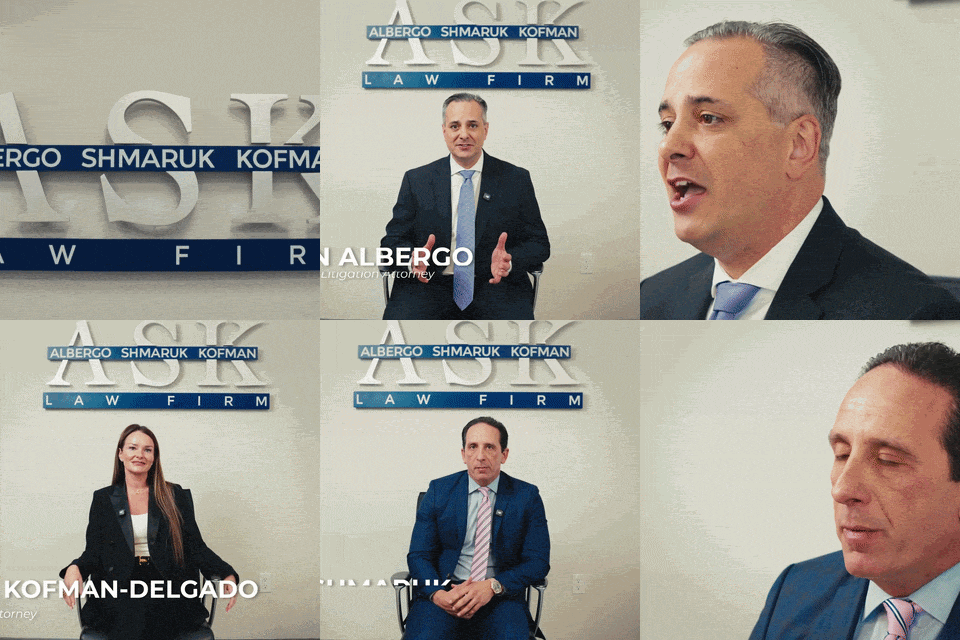
Our attorneys include Boris Shmaruk, Esq., whose practice includes plaintiff-side workers’ compensation and construction accident matters, and Yelena Kofman-Delgado, Esq., whose personal injury practice includes construction accidents and other complex injury matters.
Construction accident claims can resemble a complex chessboard. The actions of an employer, contractor, subcontractor, property owner, equipment company, and insurer may all affect the available legal options.
ASK Law Firm focuses on anticipating those issues rather than reacting to them after evidence has disappeared or an insurance company has already shaped the narrative.
From the initial investigation through negotiations or litigation, our goal is to understand the entire picture, protect your rights, and make each legal move count.
You may still benefit from having your case reviewed. Workers’ compensation and third-party personal injury claims provide different forms of compensation. If a general contractor, subcontractor, equipment manufacturer, property owner, or another party contributed to your accident, you may have a separate claim in addition to workers’ compensation.
A lawyer can evaluate the accident to determine whether additional parties or sources of compensation should be investigated.
Workers’ compensation generally prevents an employee from suing a direct employer for ordinary negligence related to a workplace accident. However, that does not necessarily prevent you from filing a claim against a negligent third party.
Construction projects frequently involve several independent companies, so determining exactly which company employed you and which companies controlled the worksite can be important.
A third-party claim is a personal injury claim brought against someone other than the injured worker’s employer.
For example, a worker employed by one subcontractor may have a third-party claim against another subcontractor that created an unsafe condition, a general contractor responsible for a dangerous common area, or an equipment manufacturer whose defective machinery caused the injury.
Yes, some New Jersey construction accidents can involve both types of claims.
Workers’ compensation may provide medical treatment, wage benefits, and disability compensation regardless of fault. A third-party lawsuit may provide additional compensation when another company or person negligently caused the accident.
Because reimbursement and lien issues can arise, the two claims should be coordinated carefully.
No. A general contractor is not automatically liable simply because an accident happened on the project.
Liability may depend on who controlled the area or work, who created the dangerous condition, who knew or should have known about it, what responsibilities were established by the construction contracts, and whether the general contractor retained responsibility for jobsite safety.
Potentially. A legitimate independent contractor may be able to pursue a negligence claim against a property owner, general contractor, subcontractor, equipment company, or another responsible party.
It may also be necessary to determine whether the worker was correctly classified. The title used in an agreement does not necessarily resolve every employment-status question.
Potentially. Equipment-related accidents may involve the manufacturer, rental company, maintenance contractor, repair company, another subcontractor, or other parties depending on what caused the failure.
The equipment should be preserved whenever possible so that its condition can be properly investigated before it is repaired, returned, or altered.
If another subcontractor created the dangerous condition or negligently caused your injury, that company may potentially be treated as a third party.
Examples could include leaving an unsafe opening, creating debris in a shared walkway, operating machinery dangerously, or interfering with another trade’s work area.
The contracts, daily reports, witness accounts, and safety records may help establish responsibility.
An insurance company may argue that you failed to recognize a hazard, used equipment incorrectly, or otherwise contributed to the accident.
Being accused of partial fault does not automatically establish that the insurer’s position is correct. The accident should be investigated using photographs, witness testimony, safety records, contracts, equipment information, and other evidence.
New Jersey’s comparative-fault principles may also affect personal injury compensation when more than one party is considered responsible.
Preserve photographs, videos, witness information, medical records, wage records, incident-report information, and any documents or messages relating to the accident.
If machinery, safety equipment, tools, or another physical item contributed to your injury, preserving that item can be especially important.
An attorney may also seek contracts, inspection logs, training records, surveillance video, safety documentation, maintenance records, and other materials that may not be readily available to an injured worker.
This is one reason early investigation matters. Construction sites may change within hours or days. Equipment is relocated, materials are removed, openings are covered, repairs are made, and subcontractors move to other projects.
Photographs, video, witness information, preservation requests, and construction records may help document conditions that no longer exist when the claim is investigated later.
Depending on the facts, a third-party personal injury claim may seek compensation for medical expenses, future treatment, lost wages, reduced earning capacity, pain and suffering, disability, scarring, disfigurement, emotional harm, and loss of enjoyment of life.
Workers’ compensation provides different benefits, so the potential recovery depends on which claims are available.
Permanent injuries can affect future medical care, employment, earning ability, independence, and everyday activities.
A construction accident claim involving permanent disability should therefore evaluate long-term losses rather than only current medical bills or the wages you have already missed.
Medical evidence, employment history, and other documentation may be necessary to establish how the injury is expected to affect your future.
Potentially. Dependents may have rights to workers’ compensation death benefits, and a fatal accident caused by a negligent third party may also raise wrongful death and related legal claims.
The available claims depend on the worker’s employment relationship, how the accident occurred, and which parties were responsible.
It is generally better to investigate a serious construction accident as early as possible.
Construction sites change, surveillance footage may be overwritten, equipment can be repaired, and witnesses may become difficult to locate. Early legal involvement can help preserve evidence, identify responsible companies, and evaluate the different claims that may be available.
Ask whether the firm handles both personal injury and workers’ compensation matters, whether it investigates third-party claims, how it identifies responsible contractors, who will handle your case, how communication works, and how fees and case expenses are addressed.
Construction cases can involve multiple legal theories and defendants. Your attorney should be prepared to investigate beyond the initial workers’ compensation claim when the evidence supports doing so.
ASK Law Firm offers free consultations for construction accident injury matters. There is no legal fee unless you win.
The consultation provides an opportunity to discuss how the accident happened, your injuries, your employment relationship, available insurance coverage, and whether workers’ compensation, a third-party injury claim, or both should be investigated.
ASK Law Firm focuses extensively on personal injury and work injury matters, including construction accidents and workers’ compensation claims.
The firm approaches legal disputes strategically. Construction cases often require attorneys to look several steps ahead because contractors, insurers, employers, and other parties may take different positions concerning responsibility.
From consultation through litigation when necessary, ASK Law Firm works to investigate the complete circumstances of the accident, identify available claims, and pursue compensation for the harm caused.
You should not have to determine on your own whether an employer, general contractor, subcontractor, property owner, equipment company, or insurance carrier is responsible for your losses.
ASK Law Firm LLC can evaluate your construction accident, review your workers’ compensation rights, investigate possible third-party claims, preserve important evidence, and help you understand your options.
Free consultations are available, and there is no legal fee unless you win.
ASK LAW FIRM LLC
Middlesex County Office
Aspen Corporate Park II
1460 U.S. Highway 9 North, Suite 301
Woodbridge, NJ 07095
Telephone: (862) ASK-FIRM
Telephone: (732) 494-3600
Email: info@asklawfirm.com
Bergen County Office
15 Warren St, Suite 20
Hackensack, NJ 07601
Telephone: (201) 354-4999
Email: info@asklawfirm.com
ASK Law Firm also maintains offices in New York City and Doylestown, Pennsylvania.